
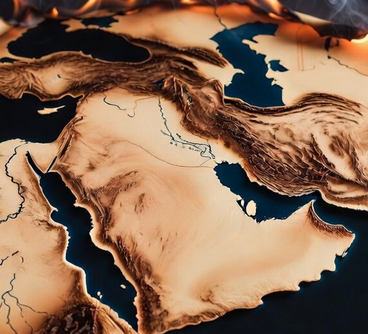
This contribution, structured around eight theses, is intended as a starting point for discussion on three deeply entrenched views of the Middle East which, in my opinion, differ profoundly from the reality that has been taking shape over the past 10–15 years.
The first is exemplified by a post by Gloria Germani on Decrescita Felice Social Network, in which the author revisits some reflections on Islamic fundamentalism and American imperialism expressed by Tiziano Terzani after the September 11, 2001 attacks, considering them applicable to the current context, despite the fact that this context has changed dramatically.
The second concerns the Palestinian cause. While my support for the self-determination of the peoples of the occupied territories of Gaza and the West Bank remains unchanged, I find it difficult to tolerate certain sanitized narratives (such as those advanced by Francesca Albanese), which in particular ignore the turn Hamas took when it embraced the Iranian project in order to establish itself as a dominant force in the region.
The third, aptly summarized by recent statements from Erri De Luca, consists of the traditional arguments in defense of Zionism, seemingly oblivious to the consequences generated by the growing political influence of ultra-religious forces, with all the risks this entails for the stability—if not the very survival—of Israel.
Normally, those who abhor Islamic fundamentalism tend to generalize the phenomenon, while those who support either the Palestinian or the Israeli cause tend to emphasize the corruption and failings of the opposing side while overlooking the shortcomings of their own, for fear of weakening it.
Yet it would be essential to step outside this logic of affiliation, detach ourselves from partisan loyalties, and observe the situation as a whole, especially because all the actors involved interact within the same process—see Thesis 8—which encompasses the entire world and not merely the Middle East.
Thesis 1 – It is natural but misleading to lump together the various military operations conducted by the United States in the Middle East since 1991 with those taking place today. Under George H. W. Bush and George W. Bush, these interventions occurred in an international context still destabilized by the end of the Cold War blocs, in which the United States was already in relative decline but remained firmly dominant.
Today, by contrast, China has emerged as the world’s leading economic power and, through initiatives such as BRICS and the Belt and Road Initiative, has created a network of alliances which—evidenced by the numerous joint military exercises conducted with Russia and Iran, such as the annually organized Maritime Security Belt drills—also pursue military objectives.
Within this framework, an important role is played by the so-called “Axis of Resistance,” the informal coalition led by the Islamic Republic of Iran and including Hezbollah, the Houthi rebels, Iraqi Shiite militias, Hamas, and, until the fall of Bashar al-Assad’s regime, Syria as well. This alliance, openly hostile not only to Israel but also to pro-Western Arab countries, has consolidated Iran’s position as a regional power.
Thesis 2 – Iran perfectly embodies the concept of “modernization without modernity” (Latouche), whereby Western technological development is pursued within an authoritarian political framework and a culturally conservative society. Yet exceptions are readily made in the name of Development, as illustrated by the paradoxical situation in which 97% of Iranian women are literate and 66% hold university degrees (70% of them in STEM disciplines), despite being subjected to a deeply discriminatory regime.
There is therefore no genuine desire to create an “alternative to the West,” but rather to replicate Western techno-capitalism within a despotic society where civil rights and liberal democracy are the only Western features being rejected. In this sense, religious fundamentalism serves the same function once performed by quasi-fascist ideologies in Pinochet’s Chile or by “socialism with Chinese characteristics.”
Thesis 3 – After winning the 2006 elections in the Gaza Strip and subsequently establishing exclusive control by eliminating rival factions, Hamas forged important ties with Iran. Despite publicly rejecting the legitimacy of the Jewish state and seeking to sabotage any peace process, Hamas benefited from a series of concessions from Israel (particularly during Netanyahu’s long and nearly uninterrupted period in office from 2009 onward), most notably the complete withdrawal of Israeli settlements from Gaza and the inflow of substantial funding through Qatar.
This strategy, aimed at strengthening an extremist actor opposed to dialogue and deepening the division between Gaza and the Palestinian Authority–governed West Bank, had the explicit objective of radically undermining the prospects for the creation of a Palestinian state.
Thesis 4 – The attacks orchestrated by Hamas on October 7, 2023, targeting military installations, kibbutzim, and a music festival, resulting in the deaths of 1,200 people and the abduction of 251 hostages, should primarily be understood within the context of Iran’s regional strategy against Israel and its overt or covert allies, rather than as acts of resistance against occupation in support of Palestinian independence.
The massive and entirely predictable bloody retaliation carried out by the most reactionary and extremist government in Israeli history could hardly benefit the people of Gaza. Indeed, Hamas’s leadership was criticized even by prominent figures within the Islamist movement itself, including Politburo member and foreign relations chief Moussa Abu Marzouk and former political adviser Ahmed Yousef.
In return, however, several objectives valued by Teheran were achieved, including:
- weakening international support for Israel, particularly by placing Muslim states that had normalized relations through the Abraham Accords—or were about to do so—in an embarrassing position;
- forcing the Biden administration to divide its attention between military support for Israel and support for Ukraine (Iran actively supports Russia’s “special military operation” by supplying drones and ammunition for artillery and armored vehicles). The slaughter in Gaza also served to divert international attention away from the Ukrainian crisis.
The pogroms of October 7 also rallied Israeli society around the government and its prime minister at a time when their popularity had reached historic lows. Was this merely an unintended side effect? Beyond speculation, one fact remains certain: in order to justify their actions, all parties involved—Netanyahu and his political allies, the ayatollahs, and Hamas—have a vested interest in ensuring that their adversaries are governed by the most extremist and brutal individuals available. In essence: “the worse, the better.”
Thesis 5 – The colonial subjugation of Palestine has been a policy broadly shared by all political forces represented in the Knesset and by governments of every political orientation since 1967. However, the siege of Gaza has inaugurated a new phase in which the logic of colonialism has increasingly given way to that of annihilation.
The cold but objective arithmetic of death speaks for itself: from the beginning of the new millennium until 2022, UN OCHA (the United Nations Office for the Coordination of Humanitarian Affairs in the Occupied Palestinian Territory) estimated between approximately 6,500 and 7,500 Palestinian deaths across all occupied territories as a result of Israeli military actions.
This figure reflected a form of sui generis colonialism, stemming from the peculiar origins of the Jewish state and the territorial contiguity between occupier and occupied. The humanitarian catastrophe in Gaza, which may approach one hundred thousand victims in only three years of fighting, clearly indicates an escalation of oppression and barbarity.
A similar situation is unfolding on the Lebanese front: from 2000 to 2023, approximately 1,200 Lebanese citizens were killed by Israeli forces; from 2024 to the present, the death toll has already exceeded 5,000.
Thesis 6 – Historically, Israeli political leadership, regardless of ideological orientation, has always understood the need to preserve principles such as liberal democracy and the rule of law from the distortions generated by militarism, chauvinism, and the barbarity resulting from the Israeli-Palestinian conflict.
In a climate characterized by the mentality of “alone against everyone,” moral boundaries are essential to maintaining national cohesion among Israelis despite political differences. And while every previous leader of the Jewish state, to varying degrees, bears responsibility for bloodshed, it must be acknowledged that they never acted primarily in pursuit of personal interests.
Netanyahu, by contrast, has used the office of prime minister to introduce legislative measures aimed at controlling the judiciary and shielding himself from charges of corruption, fraud, and abuse of power. Since October 7, 2023, he has pursued every opportunity for military escalation in order to cultivate a climate of national unity that would protect him from losing power. His statements regarding the transformation of Israel into a “Super-Sparta,” beyond mere “defensive autarky,” clearly reveal the type of state he aspires to build.
Another severe blow inflicted by “Bibi” on Israel’s institutional stability has been the political prominence granted to ultra-Orthodox religious parties. These groups, in addition to enjoying exemptions from military service, often live in separate communities governed by their own rules and educational systems, largely isolated from secular society except when receiving state support. They therefore exist in a condition of rejection of politics in its authentic sense—as a process of engagement among citizens—and are fundamentally incapable of relating to those who are different from themselves.
Figures such as Itamar Ben-Gvir and Bezalel Smotrich have distinguished themselves through anti-Arab hatred that crosses every moral red line, speaking openly about the deportation of Gaza’s inhabitants or promoting grotesquely discriminatory measures such as the death penalty exclusively for Palestinians, accompanied by celebratory toasts and birthday cakes decorated with nooses. Ben-Gvir’s globally televised arrogance toward members of the Freedom Flotilla after their arrest is merely the latest example of intolerance and fanaticism.
Yet fantasies about a “Greater Israel” simultaneously drive a stake through the heart of Zionism’s original political project, which sought to create a secular Jewish identity independent of religious authority. A turn toward theocracy would not only undermine Israeli national cohesion but also weaken Jewish solidarity worldwide. In this regard, the scathing remarks of former Prime Minister Ehud Olmert against Netanyahu and his circle are understandable:
I believe that the government of Israel is now the internal enemy. It has declared war on the state and its citizens. No external enemy we have fought over the past 77 years has inflicted greater damage on Israel than the government led by Itamar Ben-Gvir, Netanyahu, and Bezalel Smotrich. No external enemy has managed to destroy the social solidarity that formed the basis of Israeli society’s strength through every existential challenge it has faced since 1948, as the Netanyahu government has done and continues to do.
President Herzog has likewise publicly expressed concern regarding settler abuses against Palestinians and violence within prisons. Ben-Gvir’s response was to demand Herzog’s resignation.
Thesis 7 – The countries that voted against the 1947 UN resolution establishing Israel simultaneously opposed the creation of a Palestinian state. Not coincidentally, during the 1948 Arab-Israeli War, Transjordan occupied the West Bank while Egypt occupied the Gaza Strip. Palestinian refugees received by neighboring states were generally confined to refugee camps and have historically enjoyed a lower standard of living than Israel’s Arab minority.
The occupation of Gaza and the West Bank following the 1967 war has served as a powerful anti-Israeli propaganda tool, yet in practical terms it has achieved little. At various times, Egypt, Jordan, the United Arab Emirates, Bahrain, and Morocco have recognized Israel or established official relations with it. Iran itself, despite arming numerous anti-Zionist militias throughout the region, has only undertaken direct military action against Israel when directly affected by Israeli military power.
At the international level, the picture remains largely unchanged despite the pro-Palestinian rhetoric of many political leaders. Even during the worst moments of the Gaza crisis, only Turkey suspended import-export relations with Israel. China has spent years attempting to integrate Israel into the Belt and Road Initiative and remains its principal trading partner, while Russia and India continue to export essential goods.
Thesis 8 – The limits to growth concern all of human society, but in the Middle East certain dynamics are more pronounced, and there is a real risk that they may foreshadow developments that will eventually unfold on a global scale.
Recent Comments