
In the very simplified map, the green arrows indicate friendly interstate relations and alliances, the orange ones show situations of tension, and the red ones indicate open conflicts. The yellow arrow represents the difficult, though not currently tense, relations between China and the USA.
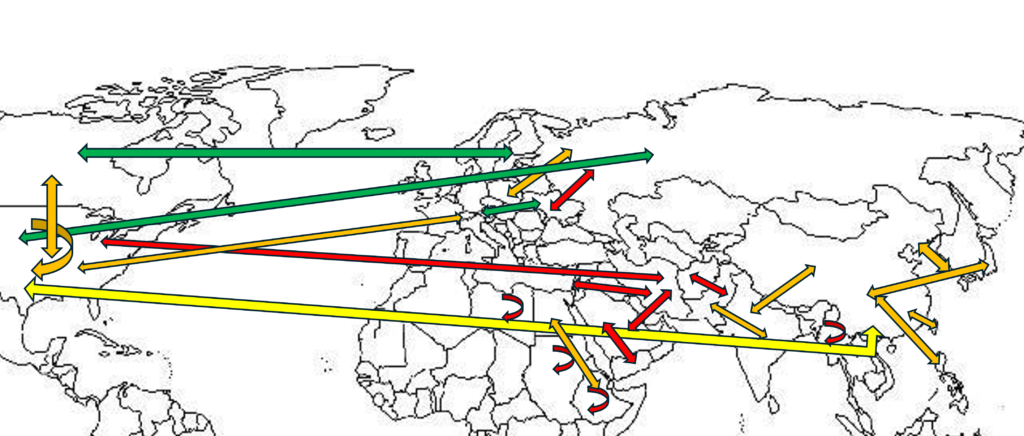
On the geographical level, there are two main “war hubs,” clearly distinct: the war between Russia and Ukraine in Europe, and the war between Israel and the USA against Iran in the Middle East. For now, they are independent, but they could merge because of both regional and global contexts.
The Russo-Ukrainian war, at least since 2022, no longer concerns just those two countries, but practically the entire “Northern World.” At first, NATO supported Ukraine — though to an extent ensuring Russia retained a clear strategic advantage, perhaps to push Putin toward compromise.
The reason for that choice is unclear, but it was probably due to a mix of factors, including the pitiful state of Western arsenals and the desire not to completely break with Putin, who ensured lucrative business for Euro-American oligarchs. Perhaps also the fear that a Russian defeat could trigger a “continental-scale Balkanization” with unpredictable outcomes.
With Trump’s rise, this policy was dropped, and the USA tried to force Ukraine and Europeans into surrender — without even consulting them. The goal was likely to show the world that the USA can fully dispose of its satellites. Yet it failed, achieving the opposite: for the first time since 1945, Europe did not align with U.S. choices. Instead, it increased support for Ukraine, which managed to abandon its role as a supplicant and gain significant geopolitical importance, ddealing on equal terms with several countries, including major ones such as Saudi Arabia and Japan.
This deepened the rift between the USA and other NATO members, who are now reorganizing themselves without seeing “Uncle Sam” as an ally — rather as a potential threat. That perception is exacerbated by the evident and ongoing collaboration between Putin and Trump who — albeit for different reasons — both long to subjugate Europe. Indeed, understanding this intent, more than the weariness from sixteen years under Orbán’s regime, convinced most Hungarians to turn the page.
In short, in preparation for the attack on Iran, Trump gambled away the political, economic, and military support of all traditional allies — not only European ones, but also Asian partners and even local Middle Eastern militias: no one trusts the USA anymore, increasingly seen as dangerous and ridiculous at the same time.
The second major ongoing war is far more complex because many other factors revolve around the Israeli-American offensive and the Iranian response. First of all, the Iranian attack on Arab countries, which so far have not responded but may do so in the future. For now, they are seeking support independent of the USA, which they clearly no longer consider reliable. Among their new interlocutors, Ukraine and Pakistan stand out.
The latter, in particular, lies at the center of a complex web. It is in open war with Afghanistan and constantly on the brink of armed conflict with India, while being a close ally of China and maintaining good relations with the USA. It had offered itself as a mediator but, after the failure of the Islamabad negotiations, chose to honor its alliance with Saudi Arabia and the Emirates, sending troops and aircraft in exchange for desperately needed cash.
All this intertwines with the various ongoing civil wars nearby — some currently almost dormant, like Iraq’s, others active, like Yemen’s. Sudan’s is the worst of all and, in different ways, involves dozens of other countries, including Arab states, Iranians, Israelis, Ukrainians, Americans, Russians, and Chinese. All of this is further complicated by a very real threat of war between Egypt and Ethiopia.
A third pole of strong tension, potentially leading to war, lies in East Asia. China openly threatens Taiwan, but also, more or less explicitly, almost all its neighbors, who so far have remained relatively calm under the American umbrella—which is now uncertain and, in any case, irreparably weakened by the conflict with Iran.
The result is a powder keg that China continues to fuel with a shrewd “artichoke policy,” aiming to corner its adversaries without fighting. Still, the military option definitely remains on the table, given the continual increase in its defense budget—even amid the country’s severe economic crisis.
As for relations between China and Iran, unconfirmed reports suggest that the Asian giant has sent its ally substantial supplies of chemical precursors for light anti-aircraft missile fuel, along with state-of-the-art radar and intelligence useful for targeting mobile American assets such as ships and grounded aircraft. If true, another piece linking the three flashpoints into one would already be in place.
These three poles are connected by the relationships among the four main nodes of the global economic network we all live in: the EU, the USA, China, and the Middle East. Europe is focusing on halting Russia and partially decoupling from the USA, even at the cost of tightening relations with China. For now, it is keeping clear of the Iranian hornet’s nest, but the recession triggered by the Israeli-American attack is global, therefore involving Europe indirectly as well.
The USA is systematically attacking Europe politically and economically (in synergy, if not even in tacit agreement, with Russia) and has unleashed hell in the Persian Gulf. It’s unclear how they intend to deal with China—perhaps by negotiating some kind of partition. One thing seems certain: they do not intend to defend Taiwan, as they are partially reducing their military presence there, as well as in Europe.
China certainly intends to conquer Taiwan (one way or another) and to expand its empire by turning neighboring countries into satellites. But it’s unclear how far it plans to go, with what means, or whether it is even truly capable of doing so.
The spectacular fiascos of Putin’s “special military operation” and Trump’s “Epic Mistake” should have shown that military superiority alone may not be enough to subdue a stubborn enemy supported by reliable allies. Meanwhile, Russia has become fully a satellite and partially a colony of China—a situation that grants Beijing broad additional room for political and military maneuver.
In the Gulf, chaos reigns. The damage is now so severe that it would take years to restore the previous economic flows — if they ever return. At the same time, Israeli offensives continue in Palestinian territories, in Lebanon, and marginally in Syria. This despite the current Syrian government having achieved more success against Hezbollah and Iran than Israel has.
A noteworthy aside: the substantial and lasting partnership among the current leaderships of Israel, the USA, and Russia.
The Possible Convergence
It’s possible that these three centers of acute crisis — the two ongoing wars and the potential third — will remain separate. But they could converge. In fact, politically and economically, they already are linked, since in different ways they involve and harm all four major nodes of the global economic network around which the world’s main production chains and trade routes are structured. The global effects are therefore amplified in many largely unpredictable ways.
Politically, the USA has been drastically reduced, if not almost erased, as a geostrategic actor, while Europe struggles merely to build a semblance of real sovereignty — if it ever succeeds. India and Indonesia remain large countries but largely marginal ones; essentially, the notorious “hot potato” is now in Mr. Xi’s hands.
He could use his power and still-considerable prestige (despite China’s severe crisis) to put out some of the hottest fires — for example, easing pressure on Taiwan, persuading Putin to accept a reasonable compromise, and mediating an armistice between the USA and Iran, thereby short-circuiting Israel.
Or he could decide that America’s weakness is the opportunity to settle the old score of the “Century of Humiliation” with everyone. He might not even need to involve his country directly in war. Imagine he ordered an air and naval blockade of Taiwan, without attacking it directly — what would the USA, Japan, Australia, and others do? Would they take responsibility for firing the first shot, or would they stand aside like we Europeans did with Crimea and part of Donbass in 2014?
At the same time, North Korean infantry and Chinese assets could enable Russia to attack Europe directly, far sooner than expected—catching us completely unprepared. How would the USA act then, having already spent much of its reserves in Iran and no longer reliable as an ally?
Iran itself, properly supplied and supported, would be perfectly capable of spreading war across much of the Middle East. Such a set of operations, in a different environmental context, could indeed make China the global hegemonic power for at least a century.
However, the current context would not allow it. Therefore, it will not allow it.
The Context
I won’t dwell again on the dynamics of the collapse of industrial civilization and the consequent drastic and rapid contraction of the human population, because the literature on this subject is immense and has been publicly available since the 1970s without interruption. On many blogs, dozens of articles can be found; anyone interested can easily read them. Authoritative books and texts are available in many libraries and can be purchased online.
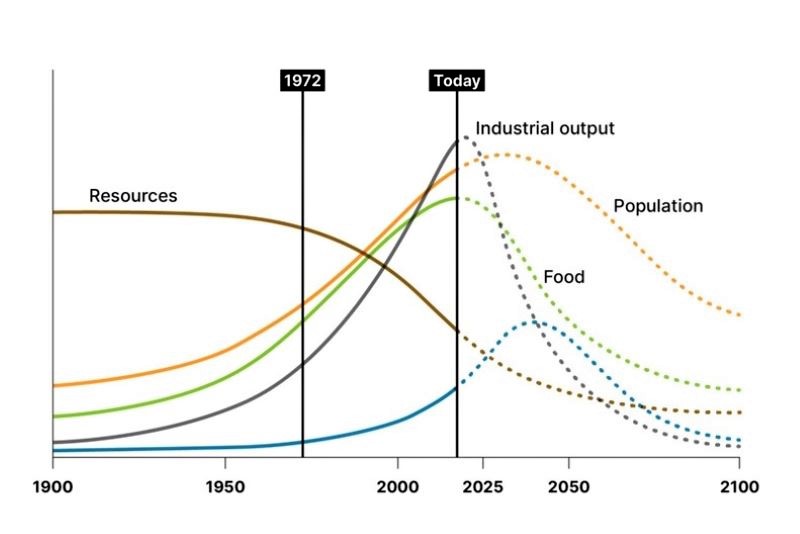
I will simply recall that, whereas previous conflicts were followed by recovery, if the situation continues to slip out of the hands of numerous and mostly incompetent puppet masters, no remedy will be possible — because we are already on the descending part of the curve. Referring to the famous “Business As Usual” scenario of Limits to Growth, it is very likely that the global peak of industrial production occurred in 2025.
If so (and we will know only after a few years), the peak of agricultural production will follow soon, and therefore the beginning of the downward curve of global population (though not necessarily uniformly across the planet). The most widely cited —though very approximate — date is currently 2030. Small and large wars are not creating the global crisis, which has in fact been developing according to plan since at least 2008; but they are greatly accelerating its dynamics and intensifying its most terrible effects.
So far, all the actions taken by Putin, Trump, Xi, and Netanyahu have served only to hasten the inevitable decline. Many others assist them — virtually all people in power, as well as most ordinary citizens — but those four figures alone bear a level of responsibility comparable to that of almost all other human beings combined.
Jacopo Simonetta
P.S. The chart is updated with real data from 1972 to 2020.
Recent Comments